

Cold freight is unforgiving in a way dry freight just isn’t.
A pallet of cardboard boxes doesn’t care if it sits on a dock for three hours in August. A pallet of romaine does. And by the time anybody notices, the damage is already done and nobody can undo it. That’s really the whole reason this corner of the industry exists.
So if you’re shipping anything with a temperature range on the label and you’ve never booked a reefer before, here’s what you’re actually buying. What refrigerated trucking companies do, what it costs right now, and the handful of questions that separate a smooth load from a claim.
What a reefer actually is
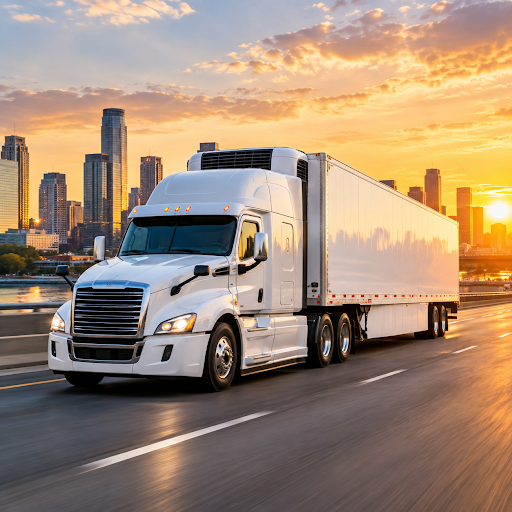
A reefer is an insulated trailer with its own refrigeration unit bolted to the front. The unit runs off a separate diesel engine, which is the part people usually don’t realize. That’s why a loaded reefer sitting in a truck stop parking lot at 3 a.m. is still holding temperature with the tractor completely shut down.
Standard length is 53 feet. Most units will run anywhere from around 20 below zero up past ambient, and yes, plenty of them heat as well as cool. In Indiana in February that matters more than you’d think. We’ve had shippers ask for reefers purely to keep products from freezing.
Multi-temp trailers are the other piece worth knowing about. Insulated bulkheads split the box into two or three zones, so frozen can ride in the nose and fresh produce in the back on the same truck. Handy. Also less common than standard reefers, so book those early.
How the temperature actually gets held
Here’s where a lot of first-time shippers get burned.
A reefer does not cool warm product down. It holds cold product cold. Those are different jobs, and only one of them is possible. If your freight comes out of the warehouse at 55 degrees and the set point is 34, that trailer is going to spend the entire trip losing a fight it was never built to win.
Good refrigerated trucking companies cool the trailer before loading. They check the air chutes and floor channels too, because the cooling works by circulating air all the way around the freight. Stack pallets tight against the sidewalls and you’ve blocked the airflow. The unit will report a perfect temperature at the sensor while the pallets in the middle ride warm.
The unit runs one of two ways. Continuous keeps the fans going nonstop and holds a tight number, which is what produce and pharma need. Cycle-sentry shuts down once it hits the set point and kicks back on as needed, saving fuel. Fine for frozen, which has enough thermal mass to coast.
And the whole time, the unit is recording. That download is the single most useful document in cold freight. When a receiver says your product arrived warm, it’s either your evidence or your problem, depending on what it says.
What moves in a reefer
Produce, obviously. Produce season is what drives most of the capacity swings you’ll notice in your rates.
But the reefer network is a lot broader than that. Frozen food runs around zero, ice cream closer to 20 below. Meat, dairy, and seafood sit in the mid-thirties. Pharmaceuticals often need a narrow band between 36 and 46 degrees with almost zero tolerance for drift. Then there’s the stuff people forget: flowers, candles, cosmetics, adhesives, certain batteries, wine. Half of it isn’t about keeping things cold at all. It’s about keeping them from freezing.
What refrigerated freight services cost right now
refrigerated trucking companies cost more than dry vans. That’s always been true. The gap got wider this year.
DAT Freight & Analytics put national average reefer spot rates at $3.42 per mile including fuel in July 2026, up three cents from June. The contract sat at $3.29, up seven cents. Dry van, for reference, averaged $3.01 on both spot and contract that month. Fuel surcharge on reefer alone ran 67 cents a mile.
The part that caught my attention: DAT reported that van and reefer contract rates posted their biggest June-to-July jumps on record, and volumes were falling at the same time. Reefer volume was down 13 percent year over year, the worst of the three major equipment types. DAT analyst Dean Croke pointed out that when rates climb while volume drops, it’s capacity setting the price, not demand.
Translation for you: there is no pile of cheap reefer capacity sitting idle somewhere. If a quote comes in well under market, somebody has a plan to make that money back, and it usually involves your load sitting.
The rulebook, briefly
If you’re moving food in the US, you’re under the FDA’s Sanitary Transportation of Human and Animal Food Rule. It came out of the Food Safety Modernization Act, took effect June 6, 2016, and compliance started April 6, 2017 for larger businesses and April 6, 2018 for small ones.
Four areas, roughly. Equipment has to be cleanable and capable of holding the required temperature. Operations have to prevent contamination and keep temperature control. Carrier staff have to be trained in sanitary practices when the written contract puts sanitary responsibility on the carrier. And records of procedures, agreements, and training have to be kept, generally no more than twelve months.
That third one is the sleeper. Responsibility follows the contract language. If your agreement never spells out who owns temperature control, you might be carrying risk you don’t know about. Sort that out before the load, not during the claim.
Picking between refrigerated trucking companies
Do the paperwork check first. Active FMCSA authority, valid DOT number, current certificates. Ask what their cargo limit actually is, because a lot of policies stop at $100,000 and plenty of reefer loads are worth more than that.
Then ask the operational stuff:
Do you pre-cool? Can I get temperature downloads on request or do I have to chase them? What happens when a reefer unit fails at midnight halfway through a lane? How do you handle detention at cold storage, where two and three hour waits are normal and nobody apologizes for them?
Listen to how they answer more than what they answer. Refrigerated freight carriers who’ve been through real failures will describe them without flinching. Anyone telling you nothing ever goes wrong is either brand new or shading the truth.
Lane fit matters too, probably more than a nickel on the rate. A carrier who’s deep in Midwest produce lanes may be thin in the Southeast.
Where these loads usually go sideways
Rarely anything dramatic. It’s almost always small process gaps.
Product loaded warm and the trailer gets blamed. Pallets jammed against the walls, killing airflow. A set point on the BOL that doesn’t match what the receiver actually expects. Dock doors stand open for forty minutes in July. Nobody takes a pulp temperature at pickup, so when the argument starts there’s no baseline to argue from.
None of that costs money to fix. It costs one conversation, in writing, where the shipper and the carrier agree on the number, who checks it, and when. That conversation prevents most of the claims I’ve seen.
Working with XPress Cargo
We’re a temperature-controlled carrier out of Indianapolis, running truckload, LTL, dedicated, drayage, and 3PL nationwide. Cold freight isn’t a line item on our services page. It’s the business.
If you’re comparing refrigerated trucking companies for a lane or an upcoming bid, call us at 317-426-5410 or request a quote on the site. Happy to talk through your temperatures, transit windows, and lane history before you commit to anything.
Questions we get a lot
What do refrigerated trucking companies charge per mile in 2026?
DAT had reefer spot averaging $3.42 per mile with fuel in July 2026 and contract at $3.29. Your number will land somewhere else depending on lane, season, commodity, temperature, and how much notice you give. The production season moves it a lot.
Why are refrigerated freight services more expensive than dry vans?
The trailer costs more, the reefer unit burns its own diesel, maintenance is heavier, and the driver carries real responsibility for monitoring and documentation. Cold storage dwell time is the quiet one though. Longer waits mean fewer miles per week per truck, and that gets priced in.
What temperature should I set my freight at?
Depends entirely on what it is. Frozen usually at or below zero, meat and dairy mid-thirties, a lot of pharma between 36 and 46. Put the exact number on the bill of lading. Don’t leave it to interpretation.
If my product arrives warm, is that on the carrier?
Depends on your contract and what the temperature record shows. Under the FDA rule, carrier responsibility for sanitary conditions applies when a written agreement assigns it. If it was loaded warm, or the receiver sat on it, that’s a different conversation. This is general information, not legal advice, so have your counsel look at your actual contracts.
Can one truck carry frozen and fresh together?
Yes, with a multi-temp trailer and bulkheads. Just request it early. There’s less of that equipment out there and it gets tight fast during produce season.
